
ALICE Cosmic Ray Detector
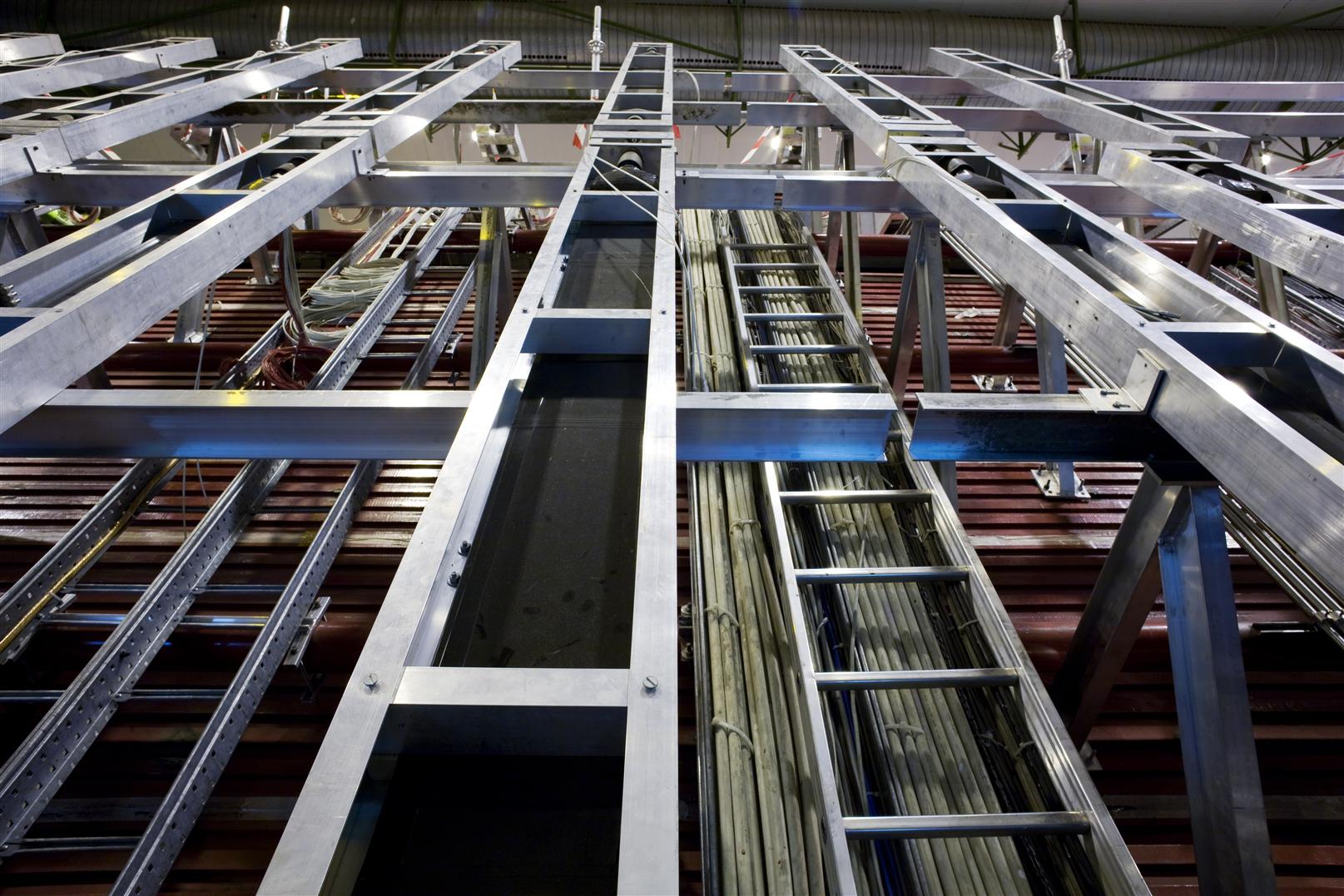
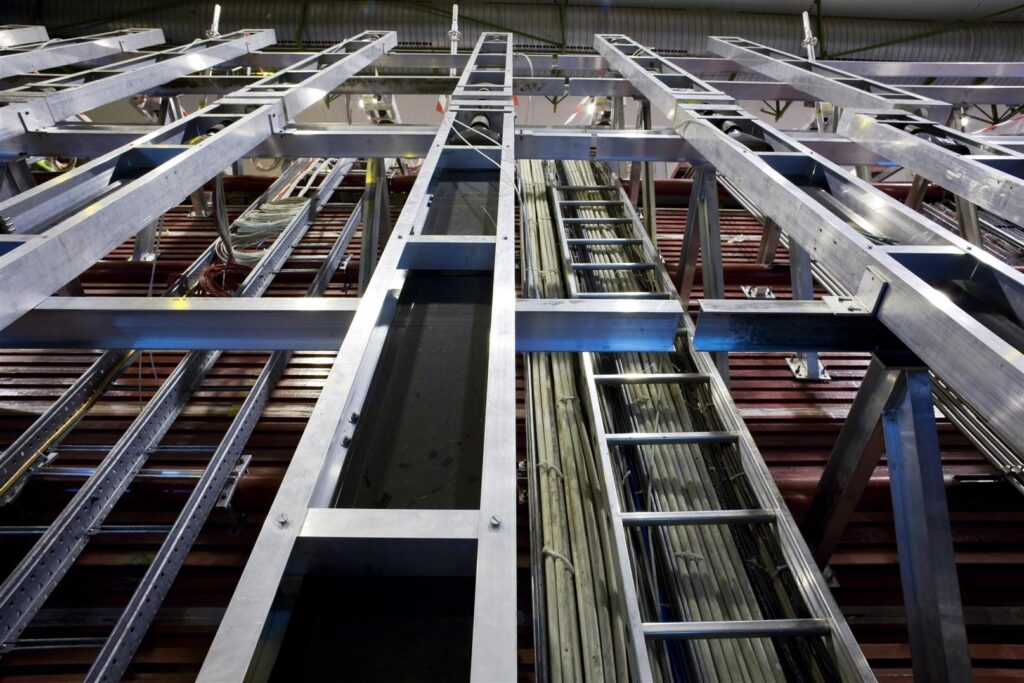
The ALICE underground cavern provides an ideal place for the detection of high-energy atmospheric muons coming from cosmic ray showers. ACORDE detects cosmic ray showers by triggering the arrival of muons to the top of the ALICE magnet.
With ACORDE, ALICE has detected muon bundles with the highest multiplicity ever registered and has also measured very high-energy primary cosmic rays.
A bit more detail:
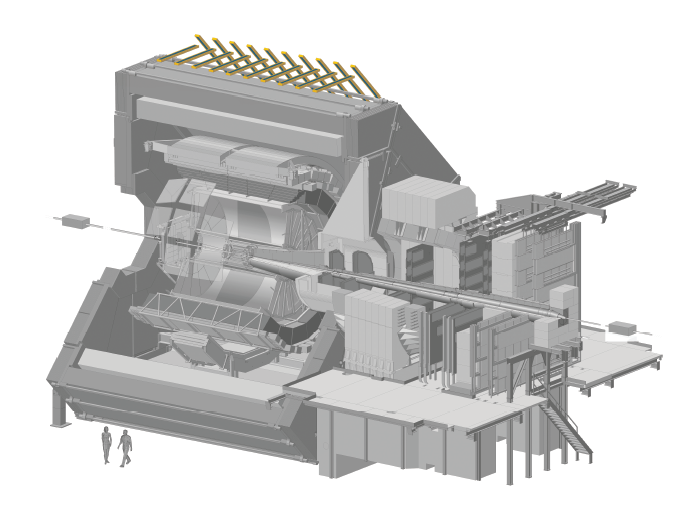
The ALICE Cosmic Ray Detector (ACORD) consists of an array of plastic scintillators placed on the upper surface of the L3 magnet. It detects cosmic ray showers by triggering the arrival of muons to the top of the ALICE magnet. The high-resolution tracking detectors available allow the recording of interesting cosmic events with very high multiplicity of parallel muon tracks, the so-called muon bundles.
Technical Details
The ALICE cosmic ray trigger is made up of 60 scintillator modules distributed on the three upper faces of the ALICE magnet yoke. Each module is made of two 0.2 x 2 m2 scintillating planes put in coincidence to minimize noise. A discrimination, coincidence, and signal conditioning front-end board is mounted on every module, as well as the corresponding Photomultipliers.
This array can be configured to trigger on single or multi-muon events, from two-fold coincidences up to the whole array if desired.
This trigger and the measurement of the properties of muons (charge, direction, momentum, and spatial distribution), due to the excellent ALICE tracking capabilities, allow us to study the nature of high-energy cosmic rays.
Click here to read more on the ALICE Cosmic Ray Detector.
Performance
A few very high multiplicity muon bundles, like the one shown in the figure, have been triggered by ACORDE and tracked by the TPC. They have an energy of up to 3 x 10¹⁶ eV and a density of up to 18 muons/m2.
Event triggered by ACORDE on 9.10.2008
The muon multiplicity distribution shown in the figure can only be explained by a combination of contributions from proton and Fe primary cosmic rays. An energy between 1013 and 1017 eV is assumed for the primary cosmic ray in the simulations.
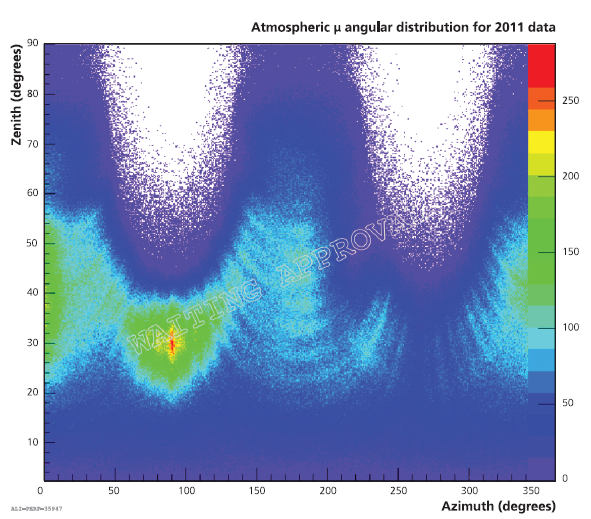
Angular distribution of atmospheric muons arriving at the ALICE cavern. The energy threshold due to the overburden rock filter is 15 GeV. The peak around 90 in azimuth and 30 in zenith angle shows the position of the access shaft.
« Previous …. Next »